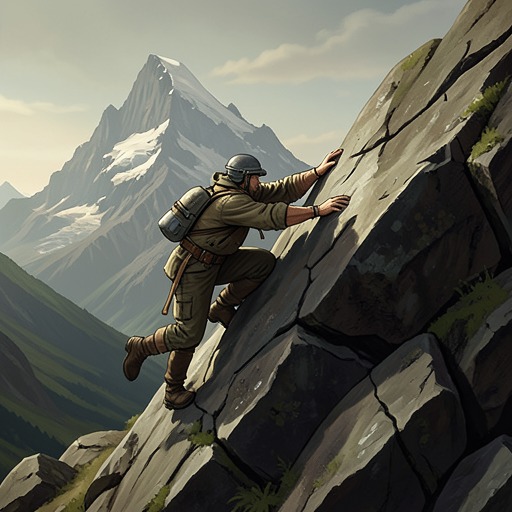
One must imagine Sisyphus happy
The Myth of Sisyphus“One must imagine Sisyphus happy” is the decisive expression of the Sisyphus myth’s philosophical reversal: a punishment designed as futile and hopeless labor becomes, through consciousness and revolt, a fate the condemned man can claim as his own. Sisyphus is not happy because his burden disappears, but because he recognizes its full meaning and refuses to grant the gods a higher authority over his days.
The Myth and Its Punishment
The gods condemn Sisyphus to ceaselessly roll a rock to the top of a mountain, where it falls back under its own weight. The sentence is presented as the most dreadful punishment because it joins endless exertion to guaranteed failure. Sisyphus’s labor has no completed product and no final release: every ascent merely prepares the next descent.
The traditions explaining his punishment emphasize his defiance of divine and mortal limits. He steals the secrets of the gods, reveals the abduction of Ægina, daughter of Æsopus, in exchange for water for the citadel of Corinth, and prefers an earthly benefit to celestial thunderbolts. He also puts Death in chains, leaving Pluto’s empire deserted and silent until the god of war frees Death. Later, after ordering his wife to leave his body unburied in the public square, he awakens in the underworld and persuades Pluto to let him return to earth to chastise her. Once he again experiences water, sun, warm stones, and the sea, he refuses to return to infernal darkness until Mercury forcibly takes him back. His punishment therefore grows from a pattern of scorn for the gods, hatred of death, and attachment to earthly life.
Consciousness in the Descent
Sisyphus becomes the absurd hero not simply because he suffers, but because he knows the extent of his suffering. The central moment is not the upward push alone; it is the pause after the rock has fallen, when Sisyphus walks back down toward the labor that will never end. That descent is an interval of consciousness. Removed for a moment from the immediate strain of lifting, he sees the whole shape of his fate and becomes superior to it.
His awareness does not cancel the punishment. The rock still waits below, and the ascent will begin again. Yet lucidity changes the relation between the man and the sentence imposed upon him. If hope of success sustained him, the labor would remain merely painful; because he understands that success is temporary and failure certain, the punishment becomes tragic. At the same time, the consciousness that exposes his misery crowns his victory. No fate is wholly beyond him when he meets it with scorn.
From Futility to Ownership
The phrase insists on an active interpretation of happiness. Sisyphus’s happiness is silent and difficult, contained in the recognition that his fate belongs to him and that his rock is his own thing. Once he contemplates his torment without appeal to the gods, the external sentence becomes a human matter. He does not discover a hidden purpose behind the labor; he refuses the demand that labor possess a purpose supplied by a higher world.
This ownership is accompanied by a wider revolt. When the universe is restored to silence and the idols are silenced, the voices of earthly life become perceptible: the faces, invitations, and secret calls of the world remain as the price and reverse of victory. There is no sun without shadow, so the night must also be known. The absurd man says yes to the world without pretending that it is rational or redeemable, and he accepts that his effort will be unceasing while maintaining that he is master of his days.
The rock thus becomes more than an instrument of punishment. Each atom of it and each mineral flake of the night-filled mountain forms a world. Its meaning lies not in reaching a permanent summit but in the struggle itself. The repeated ascent is an image of action stripped of promised completion, yet it is not therefore empty: the labor becomes valuable as the exercise of conscious human resistance.
Human Labor and the Absurd
The expression also extends beyond myth. The worker of the modern age performs the same tasks throughout life, following the rhythm of rising, commuting, working, eating, sleeping, and beginning again. Such a mechanical existence can continue under the force of habit until weariness introduces the question of why. At that point, weariness becomes the beginning of consciousness rather than merely a symptom of exhaustion.
The comparison between Sisyphus and modern labor does not erase the difference between mythic punishment and social conditions. The image nevertheless makes repetition philosophically visible: a task may be imposed, recurrent, and apparently useless, while the worker’s awareness determines whether the repetition remains unconscious submission or becomes the ground of revolt. The Oran coast supplies a related material image. Rails, dump-cars, cranes, drills, locomotives, dust, smoke, and detonations allow workers to attack the mountain and move its stone toward a jetty. The stone will outlast the people who move it, and the construction may have to begin again in a hundred years, but the heaps of rock testify to the men who act within an indifferent world.
The same tension appears in the figure of the miner exploited or shot down, whose silence artists are called upon to communicate. The absurd does not require indifference to humiliation or oppression. On the contrary, a life confronted by suffering can answer through action, speech, and solidarity without pretending that history guarantees a final justification.
The Final Reversal
The conclusion leaves Sisyphus at the foot of the mountain, where he finds his burden again. This ending is not an escape from repetition and does not promise a world beyond death; death remains the single fatality. Everything else, including joy and happiness, belongs to the sphere of freedom once the illusion of another world has been abandoned.
Sisyphus’s fidelity is therefore a higher fidelity to the earth, to his own consciousness, and to the unending act of raising the stone. His universe, now without a master, is neither sterile nor futile. The struggle toward the heights is enough to fill his heart because it is the struggle he understands and continues to undertake. Happiness is not the reward after the labor; it is the stance taken during the return, when the condemned man sees the whole burden, rejects the gods’ interpretation of it, and begins again.